
Icynelene Crawl Space Encapsulation & Vapor Barrier in Morgan Hill: What to Know First
We provide independent Icynene crawl space encapsulation and vapor barrier service in Morgan Hill, with most jobs completed in one to two days and a written price delivered before any work starts. As an independent Icynene service provider, we work on Icynene LD-C-50, MD-R-200, and other open-cell and closed-cell formulations found in South Santa Clara County crawl spaces, including the older installs near downtown and the newer applications in the East Main corridor. Typical crawl space encapsulation with Icynene-specific remediation runs between $3,800 and $7,200 depending on square footage, existing moisture damage, and whether the original foam needs partial removal. Call (669) 280-8103 for a free written estimate - we read your existing Icynene installation and tell you exactly what it needs, not what we’d like to sell you.
This page is for Morgan Hill homeowners who found Icynene spray foam in their crawl space and need to know whether it’s performing, failing, or creating problems it was meant to solve.
How Icynene Products Fail - and How We Fix Them
- LD-C-50 open-cell water absorption. Icynene’s LD-C-50 is an open-cell formulation - meaning the cell structure is intentionally permeable - and in Morgan Hill crawl spaces with seasonal groundwater rise or the clay-heavy soils near Coyote Creek, that permeability becomes a liability. We’ve pulled saturated LD-C-50 off rim joists that weighed three times its installed mass, the water held against wood framing like a sponge. Our fix: remove the waterlogged foam, dry the assembly with targeted dehumidification, then reinstall with closed-cell MD-R-200 or a proper vapor barrier system that handles the moisture load this soil profile generates.
- MD-R-200 closed-cell shrinkage at low-temperature application. MD-R-200 is Icynene’s workhorse closed-cell product, but when original installers sprayed it during cold snaps - common in Morgan Hill’s January-February window when crews rush to finish before spring - the substrate temperature dropped below manufacturer spec and the foam pulled away from concrete stem walls. You see a dark gap, sometimes an inch wide, running between foam and foundation. We cut back to sound adhesion, recondition the surface, and respray with thermal-monitoring verification so the new bond holds through the next cold cycle.
- Off-ratio curing from aging equipment. Icynene requires precise A-side/B-side ratio control, and we’ve found degraded proportioning pumps on older rigs produce foam that looks right day-one but crumbles to powder in eighteen months. In a Madison Way crawl space last year, the original installer had left a trail - tan, friable MD-R-200 that dusted off at touch. We remove the failed material entirely; patch repairs over off-ratio foam fail again because the substrate won’t support them.
- Vapor barrier incompatibility with Icynene’s surface chemistry. Standard polyethylene sheeting doesn’t always adhere to Icynene’s skin, particularly the amine-blush surface that forms on MD-R-200 in high-humidity cure conditions. We’ve seen vapor barriers taped to Icynene walls slide off within a season. We use vapor barrier systems with mechanical fastening and compatible sealants rated for spray foam substrates, or we specify a different barrier geometry that doesn’t rely on adhesive bond to foam.
- Icynene over unsealed crawl space vents creating condensation traps. Original builders sometimes sprayed Icynene directly over vented crawl space walls without addressing the air exchange path. In Morgan Hill’s pattern - warm days, cool nights, marine layer influence - that moving air hits the foam’s cool surface and condenses. The fix isn’t more foam; it’s sealing the vents, conditioning the space, and often removing the original Icynene that has become a mold substrate. We start with air sealing, always. Seal the leaks first. The insulation just holds what you’ve already captured.
Our Icynene Crawl Space Encapsulation & Vapor Barrier Process
- 1
Condition assessment with moisture mapping. We arrive with a written appointment window, photograph the existing state, and run a moisture meter across every surface. Wood framing above 20% moisture content gets flagged before we quote any work.
- 2
Blower-door or pressure-diagnostic test where accessible. On homes where the crawl space communicates with the conditioned envelope, we run a pressure-pan test - a diagnostic that measures how much air moves between crawl space and living space through specific leakage paths. This tells us whether the Icynene failure is an insulation problem or an air-sealing problem, which changes the scope entirely.
- 3
Written scope with parts specification. We specify OEM Icynene resupply when the original formulation is salvageable and compatible, or we note the quality aftermarket alternative - never proprietary lock-in, and we explain the trade-off in writing. Haven Standard Clause 1: flat price, written scope, written warranty before anyone lifts a tool.
- 4
Controlled removal and substrate preparation. Failed Icynene comes out with thermal-cutting tools, not ripping, to protect the framing. We HEPA-vacuum, treat any fungal growth with EPA-registered solution, and dry to below 18% wood moisture before new material goes in.
- 5
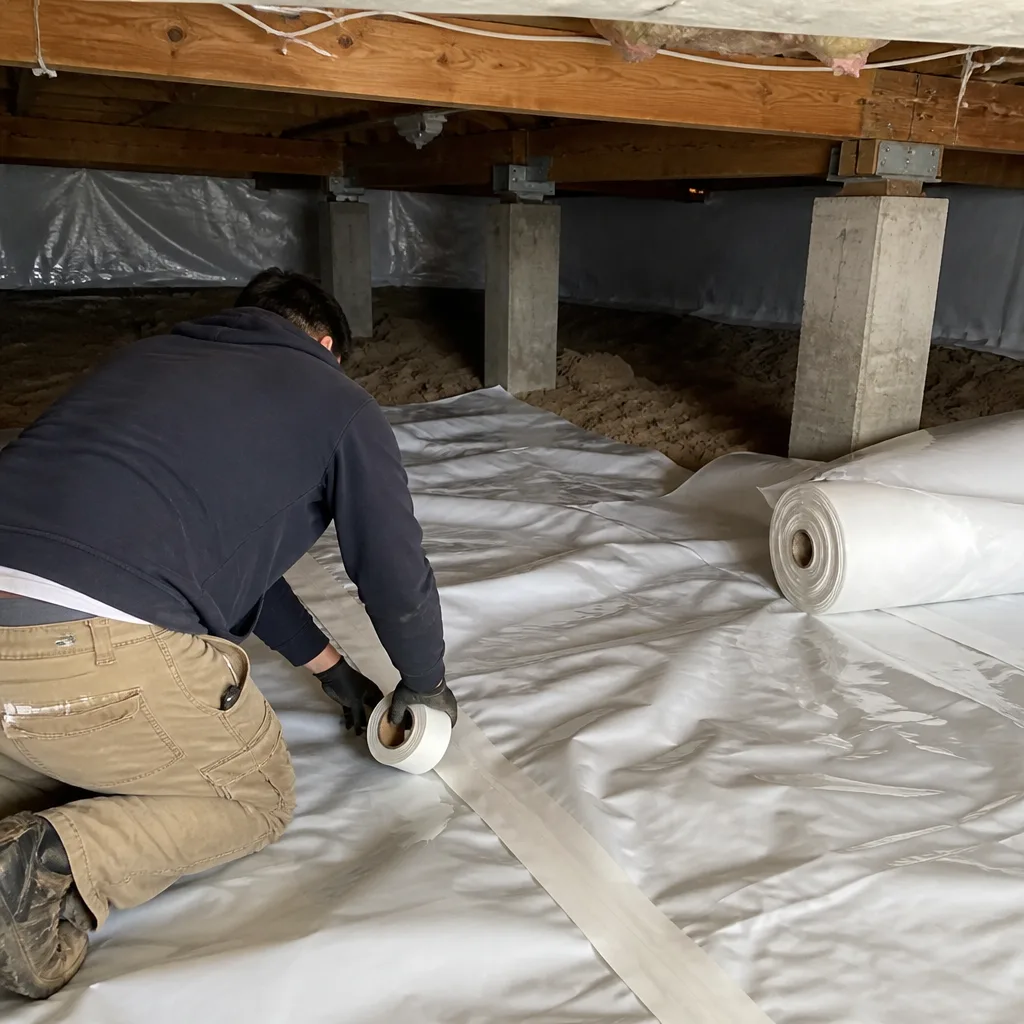
Installation with real-time monitoring. New closed-cell spray foam goes down with substrate temperature logged every thirty minutes. Vapor barriers get installed with mechanical fastening and documented overlap seams. We photograph every critical detail.
- 6
Post-work documentation. You receive a Documented Photo Record, the written warranty, and on applicable jobs, the pressure-diagnostic comparison showing what changed. The crew doesn’t leave until you’ve seen it.
What Icynene Crawl Space Encapsulation & Vapor Barrier Costs in Morgan Hill
Most Icynene crawl space jobs in Morgan Hill fall in these ranges based on what we’ve written for homes from the older stock near West Edmundson to the newer builds off Condit Road:
| Scenario | Typical Range |
|---|---|
| Partial Icynene removal + vapor barrier install, unconditioned vented crawl (under 800 sq ft) | $3,800 - $5,400 |
| Full encapsulation with new closed-cell MD-R-200, conditioned crawl (800-1,200 sq ft) | $5,800 - $7,200 |
| Remediation with structural drying, fungal treatment, and re-insulation | $7,500 - $11,000+ |
| Standalone vapor barrier over sound existing Icynene (no removal) | $2,200 - $3,600 |
What moves the price: square footage is obvious, but the bigger drivers are whether original Icynene needs removal (labor-intensive, disposal-regulated), whether the crawl space has standing water or active drainage issues we address first, and whether the home needs vent sealing and dehumidification to make the encapsulation perform. We also service Reflectix radiant barrier systems when they’re part of the same envelope - sometimes the crawl space solution ties to an attic strategy.
Call (669) 280-8103 for a free written estimate - estimates are free, and we deliver the price before any work starts.
Why Morgan Hill Homeowners Call Topside Attic Insulation Morgan Hill for Icynene Work
We’ve sealed and insulated over 9,000 homes since 2016, and the ones in Morgan Hill have specific patterns - the clay soils that hold groundwater, the temperature swings that stress foam-to-foundation bonds, the original builders who sprayed Icynene fast and vented the space anyway. Wes Okafor and our crew have worked crawl spaces from the Oakwood Avenue neighborhood up to the newer construction off East Main, and we don’t speculate about what’s down there; we photograph it, measure it, and show you.
Every job carries the 365-Day Done Right Promise - if it’s not done right, we make it right - backed by a written scope and written warranty delivered before anyone starts. Our technicians are background-checked and uniformed, and a live person answers calls 24/7, no voicemail loop. When you need Icynene-specific expertise, not a generalist who’ll treat your crawl space like any other, that’s the call to make.
FAQs
No - Icynene’s warranty covers original product defects, not independent service work, provided the repair uses compatible materials and proper application methods. As an independent Icynene service provider, we document our materials and methods so any future warranty claim has clear chain-of-custody records. Call (669) 280-8103 if you want us to review your original installation documentation with you.
We typically schedule within 24 to 48 hours for active moisture intrusion or failed encapsulation, and same-day response is often available for waterlogged open-cell foam that threatens structural framing. A live person answers our line 24/7 - describe what you’re seeing and we’ll tell you whether it needs immediate attention or can wait for a full diagnostic.
Repair is cheaper when the failure is isolated - a shrinkage gap at the rim joist, a small area of water absorption - and the surrounding foam tests sound for adhesion and density. Starting over is the better value when off-ratio foam, widespread moisture saturation, or mold colonization means repairs would be temporary patches on a compromised substrate. We give you both numbers in the written estimate so you decide with real information.
We source Icynene OEM resupply for compatible repairs where the original formulation is specified and available, and we use quality aftermarket alternatives - Owens Corning, Johns Manville, Knauf, and other named manufacturers - when they’re the better match for the remediation goal or when Icynene lead times don’t match the moisture risk timeline. We never lock you into a proprietary product; the written scope names exactly what goes in your crawl space.
Active failure signs: visible water staining on foam surface, crumbling or powdering foam, gaps between foam and substrate, musty odor that intensifies in warm weather, or wood moisture readings above 20%. Age alone isn’t failure - we’ve seen twenty-year-old Icynene performing fine in dry, sealed crawl spaces, and five-year-old foam destroyed by groundwater. We measure; we don’t guess. Call (669) 280-8103 and we’ll schedule a free condition assessment with moisture mapping.
Written by Wes Okafor, Owner & Lead Insulation Technician, Topside Attic Insulation Morgan Hill at Topside Attic Insulation Morgan Hill, serving Morgan Hill and nearby areas.